

Dr. Dipalok Bandyopadhyay : kolkata, 27th October, 2025. Introduction:- A Beginning by the RiverAs evening settles, the last rays of sunlight over the Ganga turn from gold to crimson. The air is filled with the fragrance of incense, the beats of drums, and the melodious voice of women singing devotional songs—
“Rise, O Lord Sun, bestow your blessings, O Chhathi Maiya.”This is Munger, Bihar—where every year, during the sixth day of the waxing fortnight of Kartik month, thousands gather to worship the Sun and Chhathi Maiya.
Lalita Devi, a woman in her forties dressed in a white and ochre sari, arranges offerings on a bamboo soop—bananas, apples, coconuts, sugarcane, grains, and ghee-soaked thekua. Her face is calm, her eyes soft as water.Beside her stands a foreign woman—Maya Chettri from Pokhara, Nepal—smiling with quiet joy. In accented Hindi, she says,
“In Nepal too, we celebrate Chhath. When the sun rises behind the mountains, it feels as though the light enters our souls.”Lalita smiles gently and replies,
“Yes, sister, light is the Mother’s blessing. Chhathi Maiya is the Mother of light and life.”Nearby stands Raghuvar Pandit, dressed in a white dhoti-kurta, sandal paste on his forehead, a scripture in his hand. He says,
“In the Ramayana, after exile, Sita Devi worshipped the Sun here in Munger. That is why this place is called the birthplace of Chhath.”Listening intently is Dr. Madhav Mukhopadhyay, a Puranic scholar from Kolkata. He adds,
“This is not only folklore; history also records the Chhath tradition. In the Brahmavaivarta Purana, Chhathi Maiya is known as Devasena, the consort of the Sun and the granter of offspring. The story of King Priyavrata reflects the earliest origin of this observance.”2. In the Light of History and MythRaghuvar Pandit continues,
“Look, sir, the seeds of Chhath lie in the Vedic age. The Rigveda’s Surya Sukta—‘Adityam drishtah’—says that whoever beholds the Sun attains purity of mind. From such Sun hymns arose the concept of this worship.”Dr. Madhav nods,
“True. Even in the Mahabharata, Draupadi observed Sun worship. Guided by Sage Dhaumya, she offered prayers to the Sun to relieve the Pandavas’ misfortune. Karna, the son of the Sun, offered daily salutations standing in the river. These continue today as rituals within Chhath.”Maya Chettri listens quietly, then says,
“In the Himalayas, we believe the Sun breathes life into the mountains and gives humans inner strength. So Chhath is not mere fasting—it’s a form of yoga, a union.”Raghuvar smiles,
“You’re right, sister. Chhath unites the soul with nature. Fasting and abstaining from food or water for 36 hours purify body and mind through self-restraint.”3. The Fragrance of the Kitchen and the Taste of DevotionA little away from the river, elderly Bindu Dasi sits beside a clay stove frying thekuas—made of wheat flour, jaggery, and ghee. Her granddaughter Rani watches and asks curiously,
“Grandma, why is the thekua so sacred?”Bindu Dasi smiles,
“My child, it symbolizes labor. Wheat stands for earth, jaggery for sweetness, and ghee for purity. When these mix, they become life itself—hard, yet sweet.”Sitting nearby, Ram Swarup, the cleaner of the ghats, adds,
“Chhath means clean rivers and pure minds. No one in our village throws waste in the river. Because in this water, we see the reflection of the Sun.”4. Sociology and the Festival of WomanhoodAs twilight descends, Dr. Kumar Ananta, a sociologist from Patna University, observes the rituals at the riverbank. With notebook in hand, he turns to Dr. Madhav and asks,
“This is primarily a women-led festival, isn’t it?”Madhav replies,
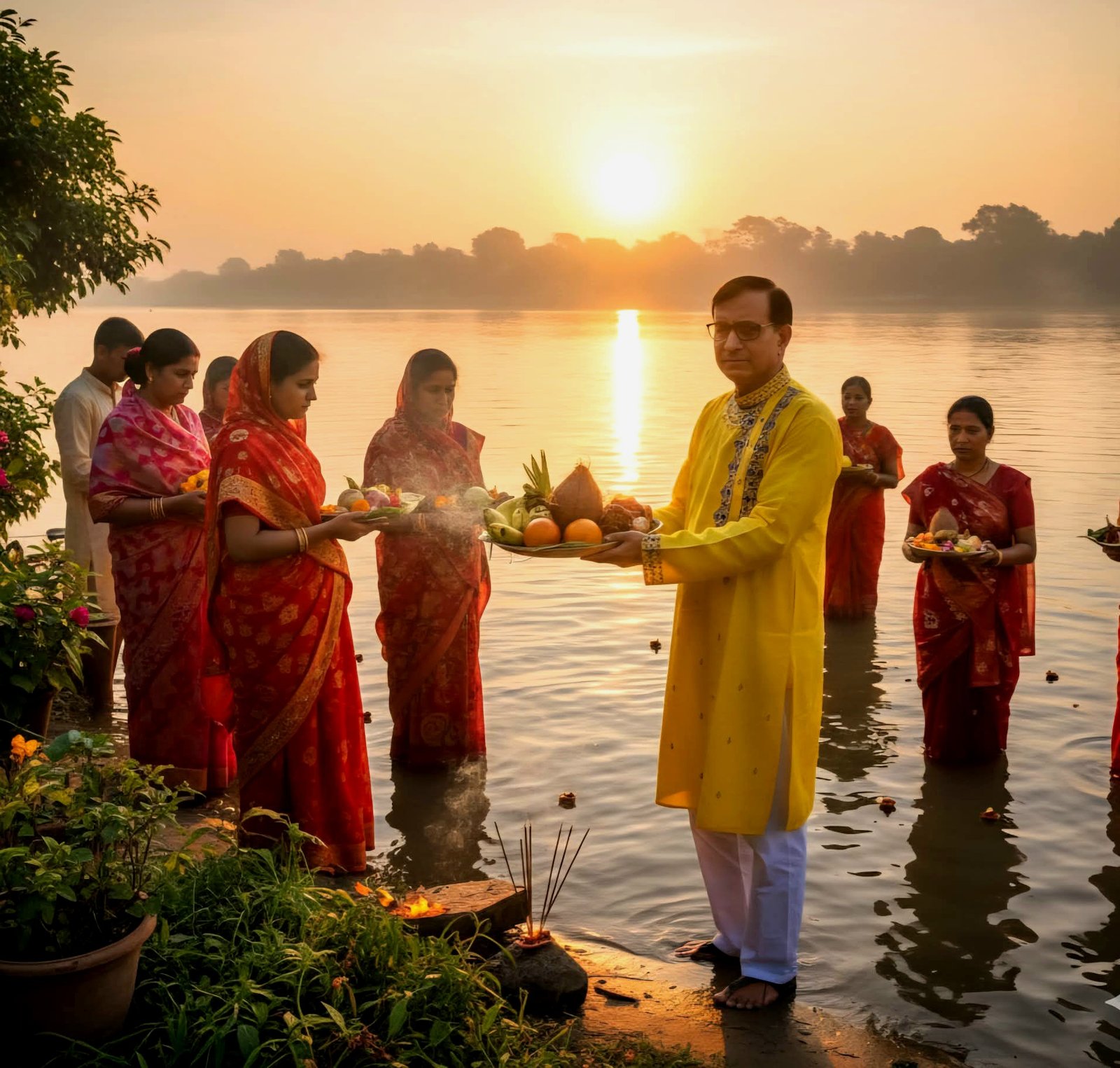
“Yes, but here ‘woman’ represents creation itself. Chhathi Maiya is Aditi—the primal energy that sustains life. In sociological terms, Chhath is the union of the feminine and masculine energies of the soul.”Dr. Ananta notes down:“Chhath Puja is a bridge of social harmony. In the light of the Sun, caste, religion, and gender dissolve. Purity means equality.”5. Offering: The Magic of SunsetAt sunset, the red Sun sinks into the river’s edge. Drums and conch shells echo as hymns rise to the sky.
Thousands of women stand waist-deep in water, holding bamboo trays filled with fruits, grains, lamps, and flowers.Lalita closes her eyes and prays,
“O Lord Sun, fill our lives with light. Bless our children, homes, and society.”Maya too lifts her hands in offering, tears shining in her eyes—pure as a Himalayan temple.
“Coming here from Nepal, I feel like I’ve found my mother’s lap again,” she whispers.Raghuvar begins chanting,
“Om Suryaya Namah, Om Shashthi Maiyai Namah.”Light and darkness blend together upon the river. It feels as though the Sun has left a spark of himself in every devotee’s heart.6. Rebirth of DawnAt early dawn, as the first rays of the Sun break the horizon, the people return to the riverside. The water glimmers, lamps float.
With sunrise, a thousand voices rise—
“Chhathi Maiya ki Jai Ho!”Peace settles over Lalita Devi’s face. Maya holds her hand and says,
“You know, I feel completely at peace today.”Raghuvar smiles,
“As the Sun returns each day, so too does the hope within our lives.”7. Conclusion: The Union of Society and the SoulBy midday, offerings are distributed—thekua, kheer, bananas, coconuts, and ghee rice fill the air with sweetness.
Dr. Ananta writes his closing note:“Though religious in form, Chhath is rooted in humanism. It restores humanity’s kinship with nature. Together—environment, family, and society—express the living philosophy of Indian culture.”Dr. Madhav adds,
“This festival proves that Sun worship is not only religious—it’s scientific and psychological. Sunlight is energy, vitamin, and the very current of life.”Lalita softly concludes,
“Maiya teaches us—stay pure, stay grateful, and live in light.”The reflection of the Sun on the Ganga seems to echo her words.
On the horizon, new light appears again—born of faith, nature, and humanity intertwined.Final Verse:“In the light of Chhathi Maiya awakens life,
In the Sun’s radiance the soul is purified.
Through the trials of fasting and the rhythm of faith, Man, nature, and myth unite in divine light. ”